


Program Brief
New Thinking on Korea's Aging, Shrinking Society
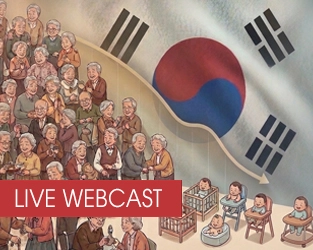
In a discussion on South Korea's low birth rate and aging society, Professor Youngtae Cho, Director of the Population Policy Research Center (PPRC) at Seoul National University, challenged conventional narratives surrounding South Korea's demographic decline. Rather than viewing a shrinking population as a critical crisis, Professor Cho reframed it as a unique window of opportunity to strategically build a more sustainable and resilient future.
This program was made possible by the generous support of the Korea Foundation and our individual and corporate members.
Key Takeaways
1. Hypercentralization in Seoul as a Fundamental Driver of Low Fertility
From an evolutionary perspective, Dr. Cho explained that when competition for resources becomes unsustainably intense, an organism's instinct for individual survival overrides its instinct for reproduction. In South Korea, this survival trigger is directly tied to hypercentralization. More than 50 percent of the national population is concentrated in the Seoul metropolitan area, where economic opportunities are clustered. Coupled with the fact that 77 percent of 30-year-olds hold a college degree—the highest in the world—metropolitan areas have become dense, high-pressure environments where young people face a brutal daily battle for survival, leaving them with no financial or psychological capacity to marry or have children.
2. Quality Over Quantity
Dr. Cho refuted Elon Musk's claim that South Korea's low fertility rate would allow North Korea to easily invade by simply "walking across" the DMZ within three generations. He revealed through recent demographic simulations that North Korea's population is facing its own severe, unmanaged decline; its annual births sit around 220,000 to 230,000, roughly equal to South Korea's 250,000 births last year. Furthermore, Dr. Cho argued that assessing a nation's future strictly by headcount is reductionist. South Korea's historic post-war transformation into a global economic powerhouse was driven by massive leaps in individual human capability and resilience, qualities that numbers alone cannot capture. Dr. Cho encouraged a perspective that looks beyond the population number to additionally consider "APC," which means age, period, and cohort.
3. The Extreme Reality of Social Aging and Shifting Median Age
Dr. Cho emphasized that a shifting age structure fundamentally transforms a nation into an entirely different world, an evolution best captured by the relentless rise of South Korea's median age. Historically, this metric dictated the baseline for cultural maturity; in 1994, the median age was a youthful 29, meaning that turning 30 marked a sudden, high-pressure threshold into full adult responsibility. Today, that midpoint has skyrocketed to 46 and by 2054, the median age in Korea will be around 60 years old. This unprecedented shift means institutions, legal frameworks, and economic systems must be completely reinvented to function in a society where the statistical average age shifts substantially.
4. Demographic Solutions for Corporate Talent Pipelines
Dr. Cho asserted that treating population decline as an automatic economic death sentence is a mistake. By looking at demographics through the multi-dimensional "APC" lens (Age, Period, Cohort), businesses can uncover massive expanding global markets and pivot their strategies. In a notable case study, one company faced high resignation rates among its newly recruited elite workforce despite offering top-tier salaries and welfare benefits. Dr. Cho's research identified a distinct demographic mismatch: 49% of Koreans born in 1990 and 51% born after 2003 are Seoul natives, thus structurally addicted to the capital's infrastructure. Forcing them to work consecutive years at regional plants hours away created an exhausting, unsustainable weekend travel loop. Acting on Dr. Cho's advice, the company introduced a bi-weekly 4-day work week in 2024, reversing attrition rates among their young talent.
New Thinking on Korea's Aging, Shrinking Society with Professor Youngtae Cho
Wednesday, June 10, 2026 | 7 PM (EDT)
Thursday, June 11, 2026 | 8:00 AM (KST)

About the Speaker:
 |
|
Dr. Youngtae Cho is a professor of demography at the Graduate School of Public Health, Seoul National University, and director of the SNU Population Policy Research Center. He received his Ph.D. in sociology (specialized in demography) from the University of Texas at Austin in 2002. His research focuses on fertility transitions, demographic change, and their impacts on social and economic structures in East and Southeast Asia. He is the author of several books for general public and has played a leading role in enhancing population literacy in Korea. Through media, public speaking, and policy consultation, Cho reframes demographic shifts not as crises, but tools for building a more sustainable and proactive future. |