



Program Brief
Privileged but Powerless
Dr. Jieun Baek described the complex psychological drivers impacting North Korea's 100,000 political elites in a discussion of her new book, Privileged but Powerless: How North Korean Elite Grievances Reveal the Regime's Greatest Weakness. Mobilizing hundreds of hours of interviews with high-level escapees, Dr. Baek argued that the elites' performative loyalty is born out of fear, obscuring a critical vulnerability within the regime's core support base. Ultimately, the very officials who seem most invested in preserving North Korea's status quo may become its most dangerous disruptors—driven not by ideology, but by simmering resentment and vanishing alternatives.
This program was hosted by the Korea Society as part of the Kim Koo Professional Series.
Key Takeaways
1. Performative Loyalty as a Mask for Survival
Dr. Baek explained that North Korea's elite face severe cognitive dissonance, masking deep internal doubts with outward performative loyalty. This hyper-vigilant behavior represents an extreme case of preference falsification, where the most outwardly compliant individuals are actually masking a volatile vulnerability born of fear and self-preservation. To handle the immense mental burden of maintaining this cognitive dissonance, some embrace escapist vices. Additionally, because expressing anger toward Kim Jong-un is fatal, elites psychologically cope with systemic failures by shifting the blame downward, venting their frustrations onto mid-ranking managers instead.
2. The Continuum of Action
According to Dr. Baek, when confronted with their grievances, North Korean political elites operate along a strict behavioral continuum ranging from passive compliance to radical change. The most common and rational choice for individual self-preservation is to simply do nothing and maintain the status quo, which can be accompanied by small acts of adjustment that introduce micro-variations into their daily lives while they maintain their required performative loyalty. For those who decide the pressure is completely intolerable, exit via defection provides a definitive escape, a phenomenon that has increased under Kim Jong-un's regime. The most distant and difficult choice on the spectrum is to push for reform by attempting to lobby for incremental policy or economic changes from within, though this option remains the furthest from practical reality.
3. Structural Barriers to Collective Action and Individual Survival Tactics
Dr. Baek addressed why covert coups or mass uprisings fail to materialize, pointing to the regime's engineering of total social atomization, which creates a pervasive culture of mutual distrust where elites never know who is incentivized to report on them. Because collective action is functionally impossible, she noted that the most rational choice for an elite member is to maintain the status quo or intentionally aim for a middle-ground professional tier. This "sweet spot" position is successful enough to provide foreign currency and market luxuries for their families, but quiet enough to avoid shining too brightly and attracting unwanted attention from ambitious rivals.
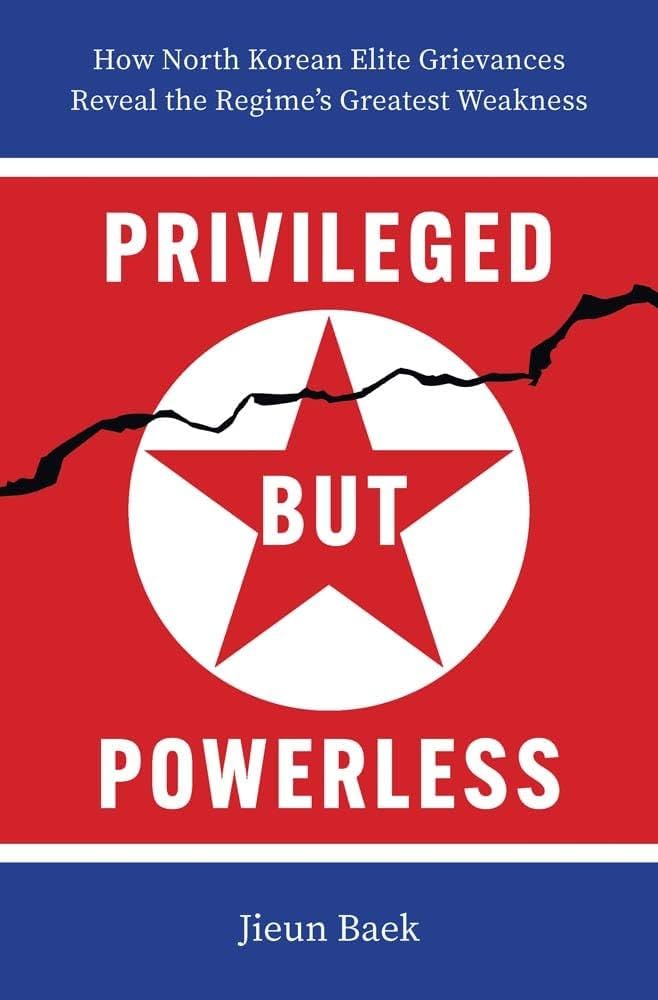
Privileged but Powerless: How North Korean Elite Grievances Reveal the Regime's Greatest Weakness
Thursday, May 7, 2026 | 4 PM (EDT)

About the Speaker:
 |
|
Jieun Baek is an adjunct faculty member at the University of Oxford's Blavatnik School of Government and a nonresident senior fellow at the Atlantic Council. She is the author of North Korea's Hidden Revolution and Privileged but Powerless, and researches elite discontent and regime instability in authoritarian states, particularly North Korea and Burma. |