


Program Brief
America's Taiwan Dilemma
During a discussion regarding his newest book, America's Taiwan Dilemma: Allies' Reactions and the Stakes for US Reputation, Mark Christopher argued that Washington policymakers often project their own assumptions onto allies. For instance, U.S. officials believe that allies demand a military defense of Taiwan to preserve America's reputation. However, through interviews with over 100 regional experts, Christopher challenged this narrative by detailing how South Korea, Japan, and Australia actually perceive Taiwan conflict risks and the reliability of US security commitments.
This program was hosted by the Korea Society as part of the Kim Koo Professional Series.
Key Takeaways
1. Reliability Matters More Than Reputation
Christopher observed that while U.S. policymakers prioritize defending Taiwan to preserve a "reputation" for resolve, regional allies focus primarily on "reliability." He defines reputation as a backward-looking assessment of past actions, whereas reliability is a forward-looking measure based on current military capability. Allies fear that if a U.S. intervention in Taiwan exhausts American military resources or political will, Washington may become unable to fulfill specific treaty obligations to Japan or South Korea. U.S. involvement in Taiwan may actually weaken alliance reliability if it leaves the U.S. military less capable of providing protection elsewhere.
2. Regional "Realpolitik" and the Lack of Alternatives
Christopher's research suggests that if China initiates a conflict, America's allies will likely be pushed closer to the United States regardless of the immediate outcome. Interviewees described a stark power reality: allied nations like Japan and Korea do not wish to acquiesce to Chinese regional hegemony, but lack the individual capability to hold off China. Without a viable alternative, allies are left with no realistic choice but to maintain and strengthen the U.S. alliance, even if a Taiwan contingency results in anger or mistrust toward Washington.
3. South Korea's Unique "Shrimp among Whales" Dilemma
Unlike Japan or Australia, South Korea does not view Taiwan as a core national security imperative because it faces the existential threat of North Korea. Experts in Seoul expressed concern that a Taiwan conflict would invite North Korean aggression or trigger Chinese economic and military retaliation on the Peninsula. Consequently, Seoul will likely "thread the needle," seeking to maintain its alliance with the U.S. while avoiding direct combat operations in Taiwan to ensure its long-term coexistence with its permanent neighbor in close geographical proximity, China.
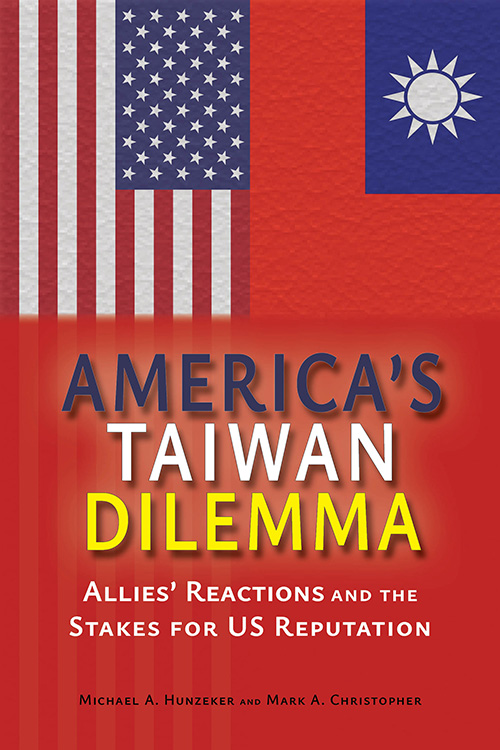
The book is available for sale here
Use the coupon code SAVE20 for a 20% discount on print editions.
America's Taiwan Dilemma: Allies' Reactions and the Stakes for US Reputation
Thursday, April 23, 2026 | 4 PM (EDT)

About the Speaker:
 |
|
Mark A. Christopher is an independent risk consultant and a nonresident fellow at the Taiwan Security Monitor. He holds a bachelor's degree from the Georgetown School of Foreign Service and an MPA from the Princeton School of Public and International Affairs. He previously studied at Peking University, Nanjing University, and Taiwan National Chengchi University. His writing has appeared in Foreign Affairs, Foreign Policy, the Jamestown Foundation's China Brief, Defense One, and the Wall Street Journal. |